Chorus Research vs SurveyMonkey
SurveyMonkey built its product for the era of manual survey creation and email-blast distribution. Chorus Research is built for the era of AI agents: programmatic fielding via MCP, AI-generated survey design, and pay-per-survey pricing with no subscription required.
The fundamental difference: consumer tool vs. developer-first research platform
SurveyMonkey has been the go-to survey tool for consumer and SMB use cases since 1999. It is well-suited for HR teams sending annual engagement surveys and marketers running one-off polls. Its product decisions reflect that: a GUI-first workflow, subscription billing, and no programmatic way to buy sample.
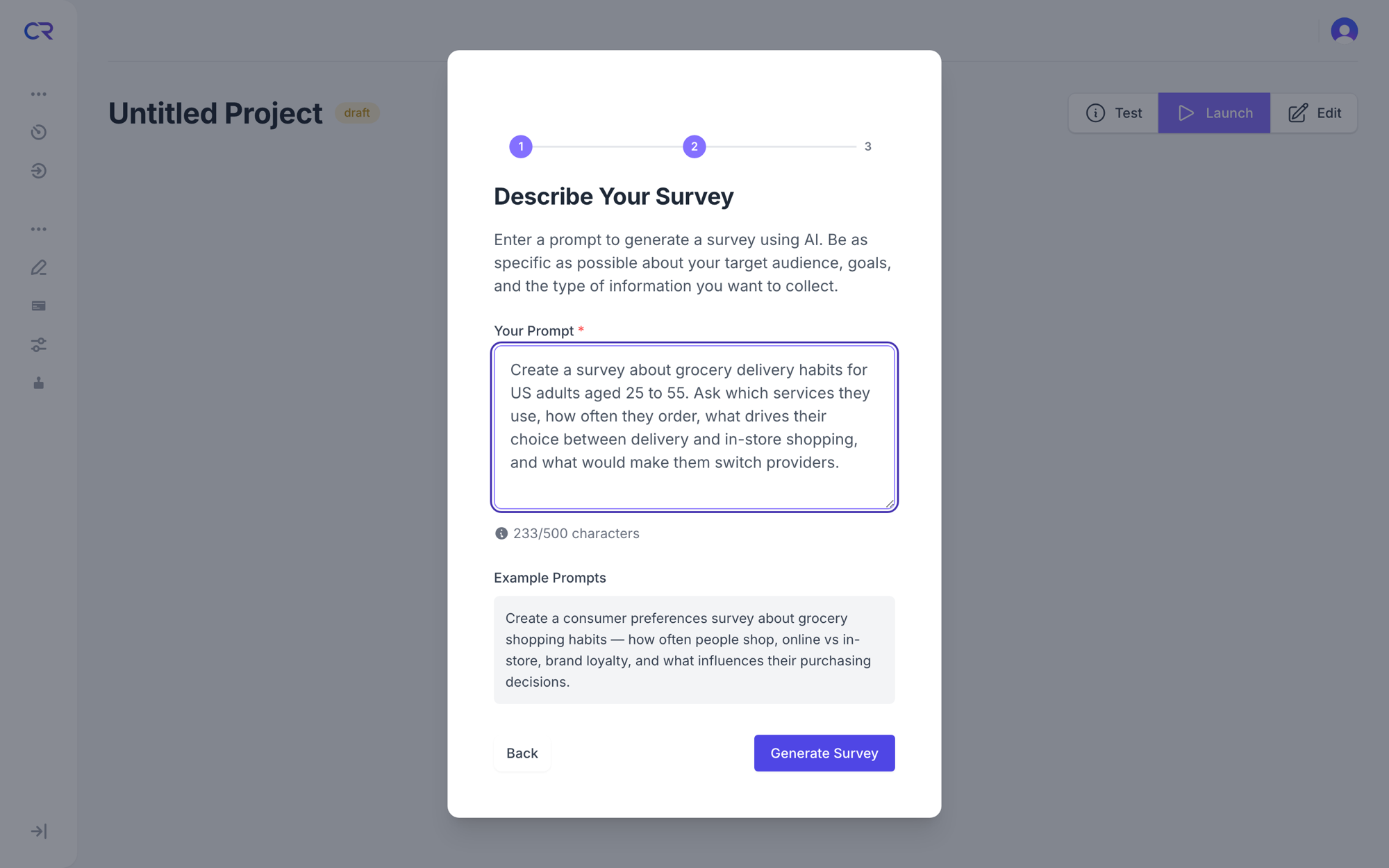
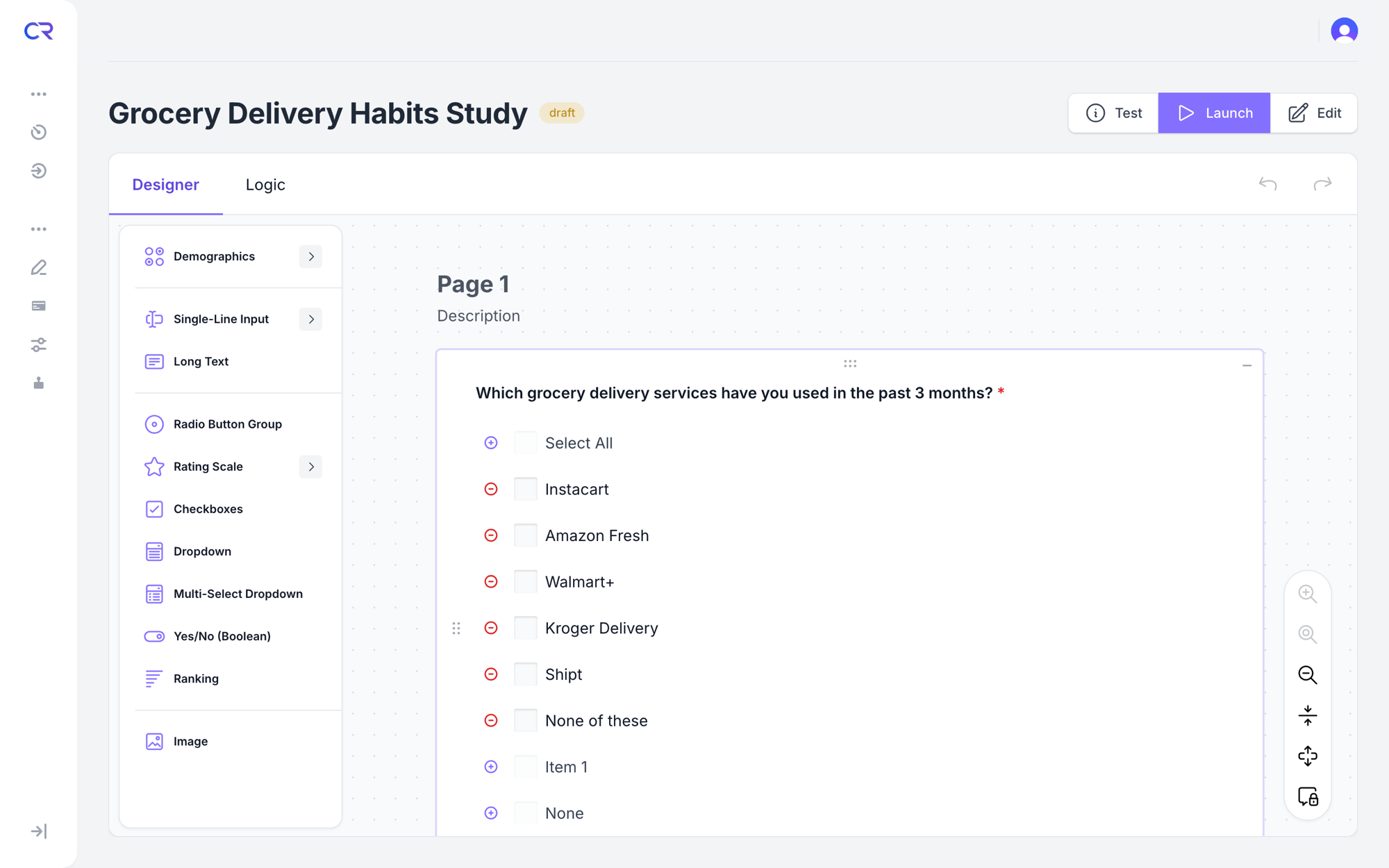
Chorus Research is architected around a different assumption: that a growing share of research will be initiated, fielded, and analyzed by AI agents, not humans clicking through a web interface. That is why Chorus ships a native Model Context Protocol (MCP) server, so any MCP-compatible AI agent (Claude, Cursor, or a custom pipeline) can design a survey, build a target audience, send the study to a panel, and retrieve results, with a human approving only the payment.
SurveyMonkey added an official MCP server in 2026 that lets Claude build surveys and read responses. What it does not expose is fielding: an agent cannot buy sample or launch a study to SurveyMonkey's Audience panel through it. That is not a criticism of their product; it simply reflects who their product is designed for.
Feature by Feature
A direct comparison across the features that matter most for modern research workflows.
| Feature | Chorus Research | SurveyMonkey |
|---|---|---|
| Pricing model | Pay-per-survey, no subscription | Subscription required; individual plans $39–$139/mo, cheapest billed $468/yr upfront ($99/mo month-to-month) |
| Free tier response visibility | All responses visible, no paywall | Only first 25 responses visible on free plan |
| MCP / programmatic fielding | Native MCP server — AI agents can design, field, and retrieve results via tool calls | Official MCP server (Claude only) builds surveys and reads responses; no panel fielding via MCP |
| AI survey design | AI generates full survey from a research goal description | AI question suggestions and Genius score (response-rate predictor) |
| API access | Full REST API for survey creation, fielding, and results; no plan gating | API limited to paid plans; full access gated to higher tiers |
| Automation / agent workflows | First-class: entire research cycle callable by AI agents, human approves payment only | MCP covers survey build and response reading; fielding and audience purchase remain manual |
| Audience panel | Built-in panel with custom audience targeting from a qualification catalog (age, region, occupation, ownership, and more) | SurveyMonkey Audience panel available (separate purchase); not reachable via API or MCP |
| Setup time | Minutes — describe your goal, AI drafts the survey | Minutes for manual builder; AI assists but human writes and reviews |
| Data export | CSV download from the dashboard, JSON via API and MCP; no plan gating | Data export requires a paid plan ($99/mo Standard or above); not available on free tier |
| Questions per survey | Unlimited | 10 questions per survey on free plan; unlimited on paid |
| Overage charges | None — pay upfront for the responses you need | $0.15 per response over plan limit |
| Target user | Developers, AI engineers, research teams building automated pipelines | HR, marketing, and CX teams running periodic manual surveys |
What SurveyMonkey's own marketing won't tell you
The 25-response free-tier trap
SurveyMonkey's free plan collects responses indefinitely but lets you see only the first 25. Respondents answer, results accumulate — and you cannot read them without upgrading. This asymmetry means teams routinely discover they have been fielding surveys for days before realizing their data is locked. Chorus Research imposes no response-viewing paywall. If you run a survey, you see every response.
Annual billing locks you in for a year
SurveyMonkey's cheapest individual plan reads as $39/month, but that is the Advantage Annual plan: $468 billed upfront for the year. The only true month-to-month individual option is Standard Monthly at $99/month, and Premier Annual runs $1,668 upfront. If your research needs are project-based rather than continuous (a product launch, a quarterly pulse, a single academic study), you are paying for twelve months either way. Chorus Research charges per survey, not per month. Run one survey in January and nothing in February, and you pay for January only.
AI features that stop short of fielding
SurveyMonkey markets AI capabilities: question suggestions, SurveyMonkey Genius (a scoring tool for predicted response rates), sentiment tagging, and since 2026 an MCP server that lets Claude build surveys and read responses. What remains missing is the fielding step: an agent cannot buy sample from the Audience panel through MCP, so a human still runs the middle of every study. Chorus Research exposes the whole cycle, including fielding, as callable tools, meaning a language model can run an entire research cycle as a side-effect of completing another task, with a human approving only the payment.
When SurveyMonkey is the right choice
SurveyMonkey remains a strong choice for teams that need a self-serve GUI, broad template libraries, and deep integration with existing HR or CX toolchains (they have native connectors for Salesforce, Zendesk, and Tableau). If your research process is human-driven, periodic, and requires little to no API work, SurveyMonkey's ecosystem advantage is real. Chorus Research does not try to replicate that ecosystem. It solves a different problem: making research a first-class capability of AI-driven workflows.
Bottom line
If you are building AI agents, automated research pipelines, or developer tools that need to programmatically field surveys and retrieve results — Chorus Research is purpose-built for exactly that. If you need a web-based survey builder with broad template support and a large user community, SurveyMonkey is a proven incumbent. The two tools are not competing for the same job.
Ready to switch to a purpose-built AI research platform?
No subscription required. Run your first survey and see the difference.
Create Free Account